_Bilingual_Traditional_Chinese.svg)


Cilia are tiny and hair-like organelles extruding from the surface of most cell types, serving either sensory or motile functions. In the eyes, the photoreceptor cells possess sensory cilia that are important for vision. Motile cilia align along the surface of the respiratory tract and function in airway clearance of mucus and inhaled pathogens. Mutations in retinitis pigmentosa GTPase regulator (RPGR) affect both photoreceptor sensory cilia and airway motile cilia, leading to retinitis pigmentosa and the rare motile ciliopathy primary ciliary dyskinesia (PCD), respectively. Not all patients develop PCD, and currently, it remains unclear which RPGR variants predispose patients to PCD.
To elucidate how loss of RPGR impacts motile cilia and contributes to respiratory disease, the research team led by Prof. Zhen LIU from the Division of Life Science at the Hong Kong University of Science and Technology (HKUST) leverages organoids, super-resolution microscopy, and live-cell imaging to investigate the nasal multiciliated cells derived from patients carrying RPGR variants, as well as CRISPR-engineered RPGR knockout multiciliated cells. The study, recently published in the Journal of Clinical Investigation, provides new mechanistic insights into this disease.
In collaboration with physicians from the Hospital for Sick Children and BC Children’s Hospital, Canada, the team analyzed a cohort of 32 patients with different pathological RPGR variants and found that defective and disorganized ciliary structures resulted in impaired ciliary beating or beat coordination. To inspect how RPGR regulates motile cilia, they utilized different super-resolution microscopy modalities and revealed the abnormal condensed apical F-actin meshwork in both patient-derived and RPGR KO multiciliated cells. Critically, these ciliary abnormalities can be ameliorated by treatments that disrupt the accumulated F-actin.
This study uncovers a distinct role of RPGR in regulating F-actin dynamics at the apical surface, thereby coordinating multiciliogenesis and maintaining proper ciliary beating. The methodologies and findings have potential clinical applications in diagnosing this rare disease and improving patient outcomes with therapeutic interventions. This work closely supports HKUST’s newly established School of Medicine and reflects the University’s increasing focus on translational medicine.
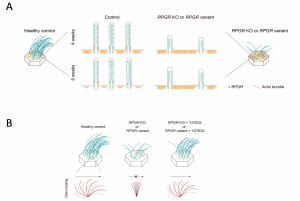
The multiciliated cells from patients with RPGR variants have spare, short, and mostly static cilia. These defects can be ameliorated by treatments that disrupt F-actin accumulation.
The link to the paper: https://www.jci.org/articles/view/193367