_Bilingual_Traditional_Chinese.svg)

Research teams from the Division of Life Science (LIFS) at The University of Science and Technology (HKUST) achieved recognition at the 51st International Exhibition of Inventions Geneva (Geneva Inventions Expo).
HKUST’s 62 participating teams won a total of 62 accolades–including 13 Gold Medals with Congratulations of the Jury, 20 Gold Medals, 20 Silver Medals, and 9 Bronze Medals. This record-breaking performance distinguishes HKUST as the highest-awarded higher education institution in Hong Kong at this year’s Expo.
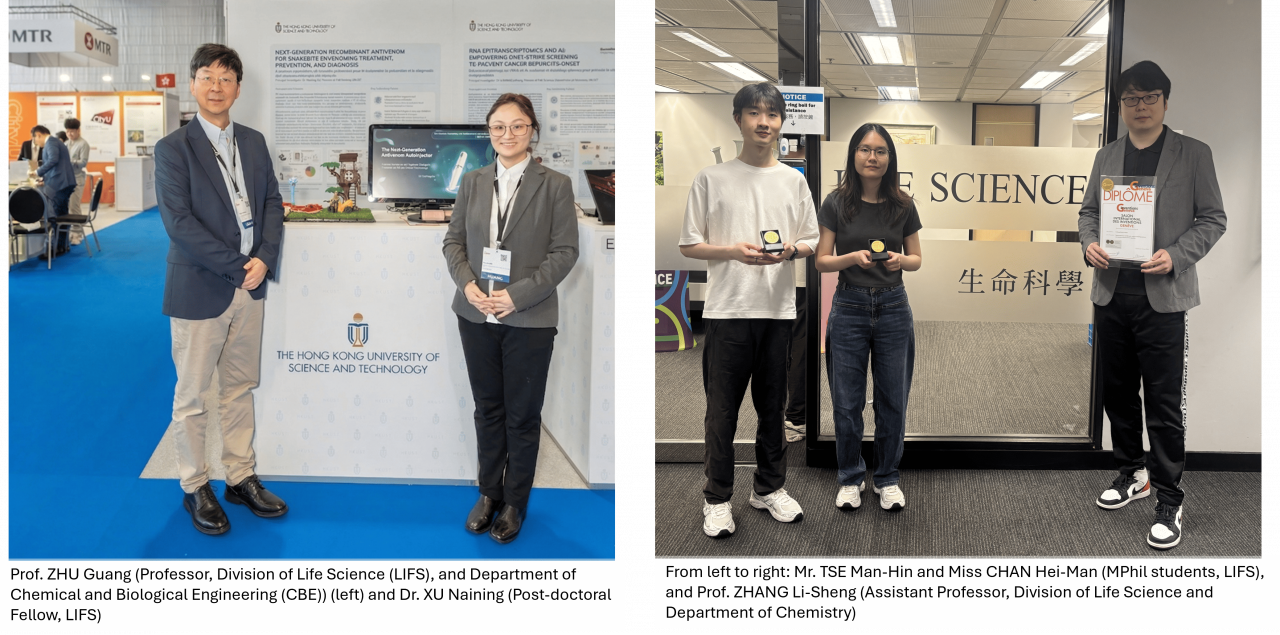
Principal Investigators: Prof. ZHU Guang, (Professor, Division of Life Science, and Department of Chemical and Biological Engineering); Dr. XU Naining, (Post-doctoral Fellow, LIFS)
The Challenge: According to the World Health Organization (WHO), an estimated 5.4 million people are bitten by snakes annually, resulting in many cases of envenoming. This leads to approximately 81,000 to 138,000 deaths each year. In Hong Kong, the Poison Control Centre reported nearly 300 snakebite‑related hospital admissions between 2021 and 2023. Traditional antivenom production involves injecting snake venom into large animals, such as horses or sheep, to stimulate antibody production. The antibodies are then extracted, a costly process that may cause allergic reactions in some individuals.
The Innovation: The team’s next‑generation recombinant antivenom utilizes human monoclonal antibody cocktails developed through a single B-cell screening platform to significantly reduce allergic responses. Lightweight and easy to use, this autoinjector enables immediate on‑site use with a single press to save critical time during emergencies.
Principal Investigator: Prof. ZHANG Li-Sheng, (Assistant Professor, Division of Life Science and Department of Chemistry) with CHAN Hei-Man and TSE Man–Hin (MPhil students, LIFS).
The Challenge: Colorectal cancer is the second leading cause of cancer deaths in Hong Kong, with a five‑year survival rate of only about 9.3% for late‑stage cases. However, colonoscopy, the clinical gold standard, is invasive, leading to low participation rates. In addition, stool‑based tests and blood‑derived cell-free DNA assays often lack the necessary sensitivity to detect precancerous lesions and Stage 0 cancers, which can delay diagnoses that could have been prevented.
The Innovation: The team has developed a novel blood screening platform, EpiLumenix, which integrates cell‑free RNA epitranscriptomics and AI to capture dynamic tumor microenvironment fingerprints from just 2 mL of blood. This platform achieves a groundbreaking 75% sensitivity for Stage 0 colorectal cancer and advanced adenomas, significantly outperforming current commercial stool and cfDNA tests. As a less‑invasive solution, it requires no fasting or bowel preparation, thereby improving patient compliance, and shifting colorectal cancer management from passive treatment to proactive, precision-based early detection and prevention.
Targeting C9orf72 G-Quadruplexes: Structure-Based and AI-Optimized Small Molecule Therapeutics for ALS/FTD
Principal Investigators: Prof. ZHU Guang, (Professor, LIFS, and CBE); Dr. XU Naining, (Post-doctoral Fellow, LIFS)
The Challenge: Amyotrophic Lateral Sclerosis (ALS) is a fatal neurodegenerative disorder characterized by the progressive loss of motor neurons. Patients face a devastating prognosis, with a median survival of only 2 to 5 years following diagnosis, and no curative therapies currently available. A major genetic contributor to ALS is the C9orf72 mutation, which involves extensive G4C2 DNA/RNA repeat expansions that form toxic aggregates and drive neuronal dysfunction. As the global incidence of ALS increases with an aging population, existing FDA approved treatments remain largely symptomatic and fail to address this underlying genetic pathology. Consequently, there is a critical unmet medical need for a true disease modifying therapy that targets the root cause of ALS.
The Innovation: Led by Prof. ZHU Guang at HKUST, the research team developed GY 368, a first in class small molecule therapy that directly targets the C9orf72 gene mutation. Using an AI driven targeted drug discovery platform, the team optimized GY 368 to selectively resolve pathogenic G quadruplex structures. In preclinical models, GY 368 demonstrated robust blood–brain barrier penetration, significantly reduced toxic RNA foci, and improved motor function without observable toxicity. By addressing a fundamental genetic cause of ALS and frontotemporal dementia (FTD), this breakthrough therapy offers new promise for extending patient survival.
These achievements underscore HKUST’s commitment to translational research, bridging the gap between laboratory discovery and real-world industrial application to improve global healthcare outcomes and drive innovation in the biotechnology sector.
For further information please visit: HKUST News-Geneva Inventions Expo